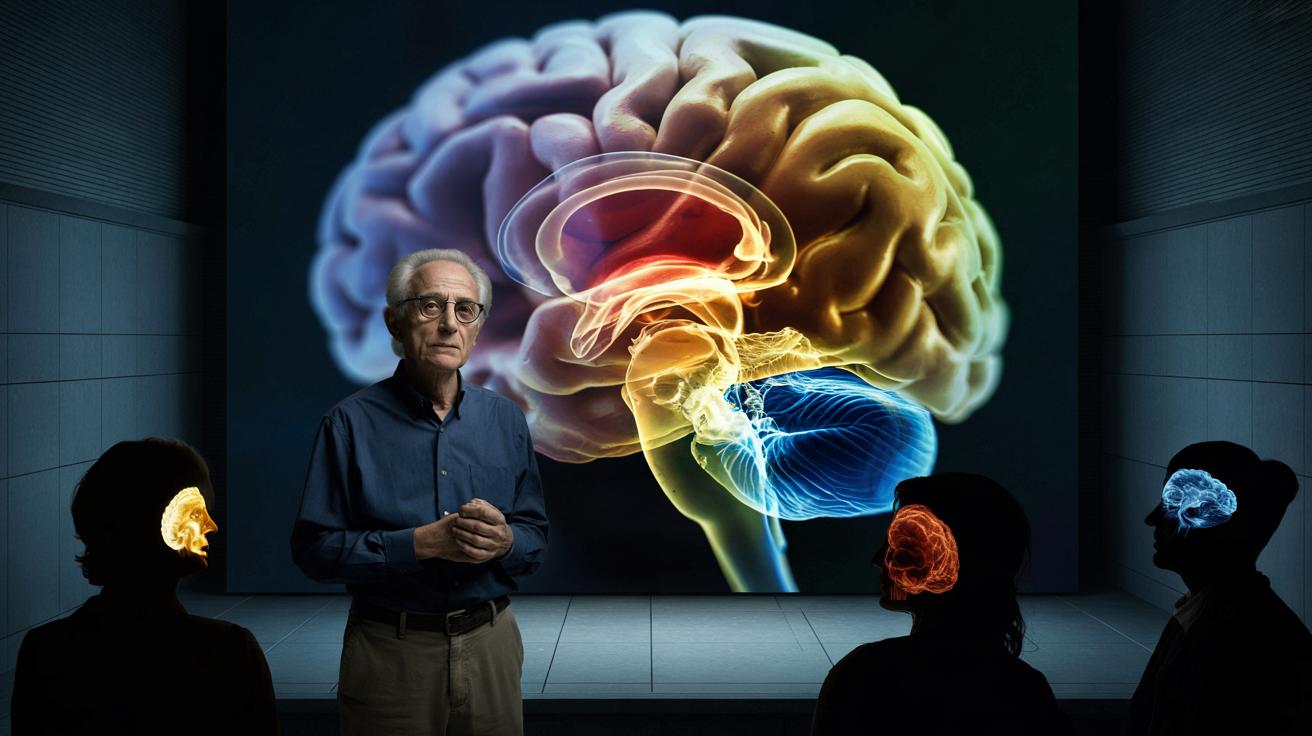
The auditorium lights are dim, but not enough to hide the phones lighting up between rows. On stage, Antonio Damasio speaks slowly, in that slightly gravelly voice of someone who has spent a lifetime arguing with big ideas. Behind him, a slide shows a brain, the cortex glowing like a bright halo. Everyone expects him to praise that glittering crown of neurons. Instead he calmly says: “The origin of our consciousness is older than our cerebral cortex.”
A small silence. Pens stop moving. You almost hear brains recalibrating.
We grew up hearing that we “are” our cortex. Our rational, talking, calculating brain. Damasio looks at that mythology and gently sets it aside.
What if what makes you feel alive started much deeper, much earlier, much lower in your skull?
When consciousness doesn’t start where we thought
Damasio’s idea hits hard because it moves consciousness away from the loftiest, most complex part of the brain and drags it down toward the basic machinery of life. He points not to the glittering cortex, but to the brainstem, the hypothalamus, those old structures we share with reptiles and fish.
These regions don’t write poetry. They regulate heartbeat, breathing, hunger, pain. They track the state of the body second by second.
For Damasio, *consciousness begins when the brain builds a story about that living body*. A primitive “I” that says: there is a body here, in this state, in this moment. Long before language. Long before thought.
A striking example appears in intensive care units. Some patients suffer devastating cortical damage after an accident or stroke. On scans, much of the cortex looks silent. You’d expect a total absence of “self”.
Yet nurses sometimes notice brief, puzzling reactions. A grimace when a loved one speaks. A change in heart rate when a familiar song plays. Tiny signs that something, deep down, is still “feeling” the world.
Damasio and other neurologists see in these cases the trace of a more ancient consciousness. Not the full cinema of images and words. A raw, bodily awareness, linked to basic regulation systems that can survive even when the cortex is largely offline. It’s fragile, but real.
From there, Damasio builds a simple but disruptive idea. What we call “conscious mind” rests on layers. At the base, old brain circuits constantly monitor the body: temperature, pressure, energy reserves. They create a kind of baseline feeling: well, unwell, safe, threatened.
➡️ “Mi sentivo fuori equilibrio”: il piccolo dettaglio che faceva la differenza
➡️ Uno squalo bianco di 750 kg monitorato da vicino dagli scienziati vicino alle coste americane
➡️ “Non mi aspettavo molto da questa ricetta, ora è parte della mia settimana”
➡️ “La vulnerabilità mi fa paura”: la psicologia spiega il rischio percepito
➡️ “Ho cambiato il modo in cui cammino nell’orto” e da allora il terreno non si compatta più
➡️ Questo taglio cresce bene senza perdere forma
➡️ “Pulivo il frigorifero regolarmente ma ignoravo la parte che causava cattivi odori”
➡️ Questo taglio alleggerisce il viso e valorizza il collo
On top of that, more recent structures, including the cortex, add images, memories, language. That’s where the narrative self appears. The life story. The internal monologue.
Yet **the foundation is not the story, it’s the feeling of being a living body**. For Damasio, the cortex is an expansion pack, not the original program. Consciousness doesn’t suddenly appear with language and reasoning. It thickens, becomes richer, more complex. The spark was already lit much earlier in evolution.
Listening to the old brain behind your thoughts
This shift changes how we look at our daily lives. If consciousness has such ancient, bodily roots, then paying attention to the body is not a “wellness trend”. It’s a way of going closer to the core of what we are.
One concrete gesture Damasio often highlights is simple: notice feelings as physical events, not just mental labels. Instead of saying “I’m stressed”, ask: where is stress in my body right now? In the chest, the stomach, the jaw?
That act of quiet scanning reconnects the modern, chatty cortex with the silent data coming from deeper circuits. It’s almost like tuning a radio so that the old brain’s signal comes through the static of thoughts.
We’ve all been there, that moment when your body knows before your mind catches up. You say yes to a project, and your neck stiffens instantly. You walk into a room, and something feels off before you can say why.
Classic psychology used to treat these sensations as bias, noise to be filtered out in favor of “rational” thinking. Damasio flips the script. He argues that emotions and bodily feelings are decision tools, shaped over millions of years to help an organism survive.
That doesn’t make them infallible. But ignoring them, or numbing them out, cuts the cortex off from its oldest, richest source of information. Let’s be honest: nobody really lives only from pure logic, no matter what they post on LinkedIn.
Damasio sums it up in one of his most quoted lines:
“Feelings are mental experiences of body states, which arise as the brain interprets emotions.”
These “mental experiences of body states” are not decoration on top of reason. They are the ground from which reason grows.
If you want to bring this down to earth, here are a few everyday practices aligned with his view:
- Pause three times a day to name what you feel in your body, not what you think in your head.
- Before a big decision, sit quietly and track subtle bodily changes when you imagine option A vs option B.
- When you’re overwhelmed, focus on your breathing rhythm and heartbeat rather than on the story in your mind.
- Notice how hunger, fatigue or pain instantly reshape your “personality” in that moment.
- Use these signals as data, not as orders: they inform you, they don’t have to rule you.
This is where Damasio’s neuroscience slips quietly into daily life without needing any brain scan.
What an ancient consciousness changes in how we see ourselves
When you follow Damasio’s reasoning to the end, something shifts in the mirror. You’re no longer just the voice in your head, that internal commentator that never shuts up. You’re also the silent choreography of organs, hormones, electrical impulses, all weaving the background feeling of being alive.
That background, for him, is the true cradle of consciousness. It’s not clean, not always pleasant, not always flattering. Yet it anchors us.
This perspective can be strangely comforting. If consciousness began long before philosophy and smartphones, then what you are is not as fragile as your latest thought. It’s older, thicker, more animal. And that doesn’t make you less human. It might be what keeps you human.
| Key point | Detail | Value for the reader |
|---|---|---|
| The origin of consciousness predates the cortex | Damasio locates its roots in ancient brain structures linked to bodily regulation | Changes how you imagine your “self” and your mental life |
| Feelings are maps of the body | Emotions express real-time states of the organism, not just “irrational noise” | Gives you a new lens to interpret stress, anxiety, fatigue or joy |
| Listening to the body refines decisions | Integrating bodily signals with thought leads to more grounded choices | Offers practical ways to align daily decisions with your deeper needs |
FAQ:
- Is Antonio Damasio saying the cortex is useless?No. He sees the cortex as a powerful expansion of consciousness: it adds language, reasoning, imagination. He simply argues that the basic sense of being alive appeared earlier, in older brain systems that monitor and regulate the body.
- Does this mean animals are conscious too?For Damasio, many animals with complex nervous systems and body-regulation circuits likely have some form of consciousness, especially mammals and birds. It wouldn’t be human-style self-reflection, but a felt sense of being a living body in the world.
- How does this theory change psychology or therapy?It supports approaches that work with sensations, posture, breathing and the nervous system, not only with thoughts. Body-focused therapies, mindfulness and emotion regulation fit well with Damasio’s notion of consciousness rooted in the living organism.
- What about artificial intelligence and conscious machines?Damasio is skeptical that pure computation, without a living body to regulate, can generate real consciousness. For him, a conscious system needs to manage its own survival, energy and internal states, not just process symbols or data.
- Can I “train” my consciousness with his ideas?You can’t rewind evolution, but you can refine awareness of what’s already happening. Regularly noticing bodily feelings, linking them to context, and integrating them into your decisions brings your modern cortex back into dialogue with its ancient roots.