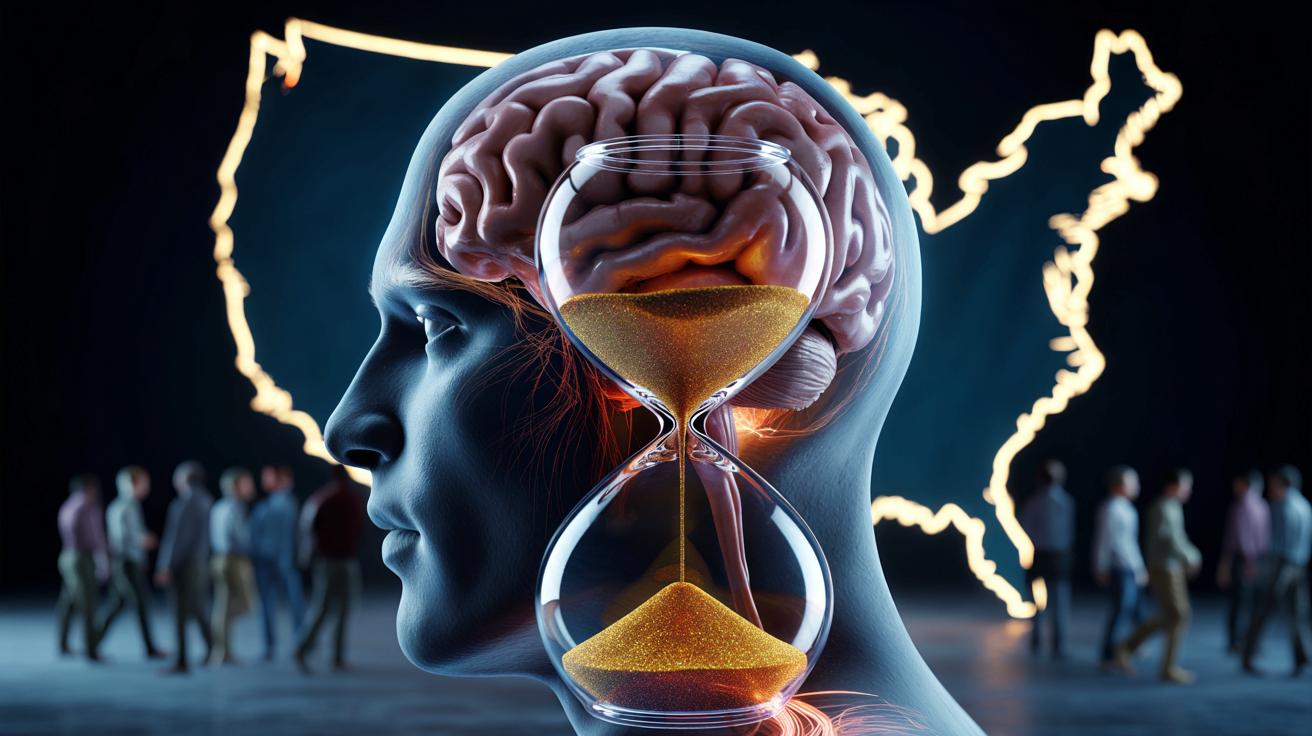
New research from the Max Planck Florida Institute suggests that two key brain regions coordinate our every move by tracking time with surprising precision, a finding that could eventually transform how doctors tackle movement disorders affecting thousands of families across the country.
How the brain keeps time without a clock
We can tell a joke, catch a ball or cross a busy road because our movements are timed to the split second. Yet the brain has no clear “clock organ” like the eye for sight or the ear for sound. The study, published in the journal Nature, offers one of the clearest pictures yet of where this hidden timing system sits and how it works.
Scientists focused on two regions already linked to movement:
- Motor cortex – the area that plans and sends commands to muscles
- Striatum – a deep structure involved in habit, reward and movement control
Working together, the motor cortex and striatum appear to track passing time in a way that mimics an hourglass, allowing the brain to launch precise, well-timed actions.
This “neural hourglass” helps explain why damage to these regions, as seen in Parkinson’s disease or Huntington’s disease, often scrambles timing and makes movements slow, jerky or poorly coordinated.
Inside the hourglass: motor cortex on top, striatum below
To test how this system operates, researchers trained mice on a simple but demanding timing task: they would only receive a reward if they licked a spout at the right moment, such as roughly one second after a signal. That forced the animals to judge short time intervals again and again.
During this task, the team recorded the activity of thousands of neurons in both the motor cortex and the striatum. The pattern that emerged fit an hourglass model remarkably well.
The flow of “neural sand”
The motor cortex acted like the upper chamber of an hourglass. Its neurons sent a flowing stream of signals down to the striatum. In the striatum, those signals built up gradually, echoing grains of sand piling at the bottom of the glass.
Once the accumulated activity in the striatum reached a certain threshold, the brain seemed ready to trigger the movement at just the right time.
➡️ A frost-hardy shrub that perfumes the garden all year: the secret to an enchanting outdoor space
➡️ “Sono un tecnico di pianificazione e guadagno 42.600 euro l’anno senza straordinari”
➡️ Cosa significa, secondo la psicologia, quando una persona interrompe sempre gli altri mentre parlano
➡️ «Pensavo che 50 euro a settimana fossero nulla, poi ho scoperto che diventano 2.600 euro in un anno»
➡️ Perché il riso integrale cuoce più lentamente e resta comunque sodo
In practical terms, that meant: when the striatal activity crossed a given level, the mouse was likely to lick. If that level was reached too early or too late, the timing — and the reward — would be off.
Stopping and rewinding the brain’s internal stopwatch
The real breakthrough came when scientists started interfering with this system. They used optogenetics, a technique that allows researchers to temporarily silence specific brain regions with brief flashes of light. This let them “poke” the hourglass and watch what happened to time in the animal’s brain.
When the motor cortex goes quiet: time pauses
When researchers briefly silenced the motor cortex, the stream of signals into the striatum stopped, as if someone had pinched the neck of the hourglass.
- The flow of neural activity to the striatum halted.
- The build-up of activity slowed or paused.
- The mouse licked later than usual, as though its internal stopwatch had been held in place.
Shutting down the motor cortex temporarily seemed to “freeze” the internal timer, delaying the movement without fully resetting it.
When the striatum is silenced: time rewinds
The effect was different when the team shut down the striatum instead. In that case, the build-up of activity — the neural sand pile — was effectively wiped and had to start again.
That reset produced an even bigger delay in the licking behaviour, as if the clock had been turned back, not just stopped. In the hourglass analogy, this was like flipping the whole device over so the count begins from zero again.
Silencing the striatum worked like a hard reset of the timer, pushing actions further into the future, as if time had been rewound inside the animal’s brain.
Why this matters for Parkinson’s, Huntington’s and beyond
The motor cortex and striatum are both heavily affected in several major movement disorders. In Parkinson’s disease, the circuits that feed the striatum lose dopamine, disrupting its ability to control movement. In Huntington’s disease, cells within the striatum degenerate over time.
| Condition | Key brain region affected | Common movement problems |
|---|---|---|
| Parkinson’s disease | Striatum and related dopamine pathways | Slowness, stiffness, difficulty starting or stopping movement |
| Huntington’s disease | Striatum degeneration | Involuntary jerks, poor coordination, timing issues |
By showing how these regions share timing duties, the new study gives doctors and researchers a more detailed target: not just “movement control” in general, but the way the brain measures when to start, adjust or stop a movement.
That has clear implications for treatments. Deep brain stimulation, new drugs or future gene therapies might one day be tuned to restore the internal hourglass, not only raw strength or muscle control. If the timing signal can be stabilised, everyday tasks — standing up from a chair, walking through a doorway, speaking clearly — could become smoother and safer.
From mice to people: what could change in everyday life
The research was done in mice, but the basic architecture of the motor cortex and striatum is strongly conserved in humans. Our ability to speak fluently, play an instrument, type on a keyboard or brake a car at just the right moment all rely on fine-grained timing.
Consider a few everyday examples where this internal hourglass likely plays a role:
- Holding a note while singing, then ending it cleanly on the beat
- Waiting just long enough at a junction before merging into traffic
- Timing a tennis serve so the ball hits the racket at the perfect height
- Pausing a split second during conversation to avoid interrupting
In each case, the brain is quietly counting milliseconds and seconds, then turning those counts into motor commands. If that timer runs too fast, actions come early and feel rushed. If it runs too slow or keeps resetting, actions lag, stutter or fail entirely.
Key terms that help make sense of the findings
Two concepts from the study are especially useful for readers trying to follow the science:
- Neural activity: the electrical and chemical firing of brain cells, which researchers can record with tiny electrodes.
- Optogenetics: a method where neurons are genetically modified to respond to light, allowing scientists to switch them on or off extremely quickly.
By combining those tools, the team could not only watch the internal timer at work but also nudge it, pause it or reset it, something that was nearly impossible a decade ago.
What this could mean for future therapies and training
If later research in humans confirms a similar hourglass-like mechanism, it could reshape rehabilitation strategies. Physical therapists might design exercises that specifically train timing – not just strength – in people recovering from stroke, brain injury or early-stage movement disorders.
There is also a mental-health angle. The striatum and related circuits help shape habits, routines and even the timing of our decisions. Subtle changes in this circuitry have been linked to conditions such as obsessive-compulsive disorder and ADHD, where timing of actions and impulses often feels off-balance.
Understanding how the brain’s internal hourglass can pause, drift or reset might eventually help clinicians fine-tune not only movement, but also patterns of behaviour and decision-making.
For now, the findings remain at the research stage, but they sketch a concrete scenario: therapies that stabilise the flow of neural “sand” through this hourglass could improve walking, speech and coordination for people across the country living with motor disorders. Even healthy people might one day benefit from training methods that harness this timing system to sharpen performance in sports, music or high-pressure jobs where every split second counts.