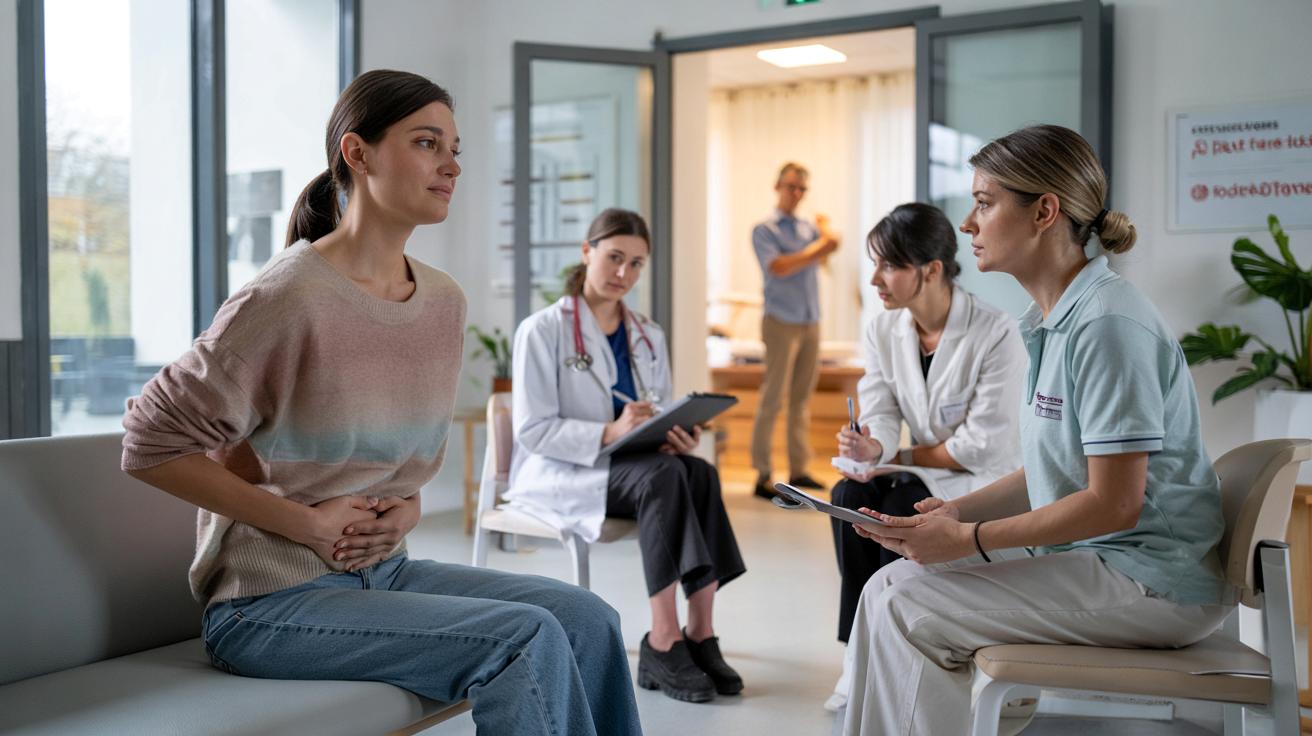
In the waiting room, the chairs are the same as anywhere else in Seine-et-Marne: gray, a bit cold, lined up against a white wall. Yet the energy feels completely different. A young woman in jeans massages discreetly her lower stomach. Another scrolls through her phone with that tense, distant look of someone who knows the pain will come back tonight, or tomorrow, or in the middle of a meeting. No one talks loudly, but nobody looks especially sick either. That’s the strange thing about endometriosis: on the outside, you “look fine”. Inside, it’s another story.
Here, at this brand-new day hospital dedicated entirely to endometriosis, the usual rules of gynecology seem to have shifted. The gynecologist doesn’t work alone. Next door there’s a psychologist. A physiotherapist. A dietician passing by with a notebook under her arm. The door to the pain clinic stays half open.
Something is happening in Seine-et-Marne, quietly, almost modestly. Yet for thousands of women, it could be a small revolution.
In Seine-et-Marne, a day hospital that finally believes women’s pain
The new day hospital dedicated to endometriosis has settled into an ordinary-looking building, somewhere between a shopping zone and a residential district. From the outside, you’d never guess that inside, years of wandering from doctor to doctor are being gently undone. Women arrive with thick folders of test results, MRI scans, ultrasound reports, often with a hint of mistrust in their eyes.
They’ve heard everything. “It’s just your period.” “You’re a bit stressed.” “Have a baby, it will pass.” Here, the first consultation takes time, and that alone feels almost luxurious. The gynecologist asks about the pain, but also about work, fatigue, sex life, sleep. Not out of curiosity. Because all of it is connected.
By the end of the morning, the same woman who walked in with crossed arms finds herself with an actual care plan. Several names on a sheet of paper. A timeline. Follow-up. For once, endometriosis isn’t treated like a side issue, or an afterthought.
Take Anaïs, 29, from the outskirts of Meaux. She started having unbearable periods at 15. Every month, she’d faint in the school bathroom, doubled over on the cold tiles. The nurse used to offer her a hot water bottle and call her mother. Years later, the pattern followed her to the office: sick days, painkillers swallowed on an empty stomach, anxious glances at the calendar before planning a meeting.
She saw six different doctors before someone finally wrote the word “endometriosis” on a prescription. Eight years. In-between, there were remarks that still sting: “You’re just sensitive,” “you exaggerate a bit,” “lots of women have that.” When she heard about the day hospital via a local association, she didn’t believe in it. Another place, another waiting room, more disappointment, she thought.
Yet after her first day there, she came out a little stunned. She had met a gynecologist, a psychologist, and a physiotherapist. They had explained what was happening inside her pelvis with simple drawings. No one minimized her story. No one rolled their eyes when she spoke about pain during sex. When she left, clutching an information leaflet, she cried in the car, more from relief than sadness.
Behind this new structure lies a simple observation: endometriosis doesn’t fit neatly into a single medical specialty. Lesions in the pelvis, digestive disorders, chronic pain, emotional exhaustion, sometimes fertility issues — one doctor alone can’t hold all of that. That’s why this day hospital in Seine-et-Marne gathered a whole team under the same roof, like a small village battling the same invisible enemy.
➡️ “Pulivo le superfici ma usavo sempre il panno sbagliato”
➡️ Questo errore mentale rende le giornate più pesanti
➡️ Psicologia: 9 tratti della personalità comuni alle persone che amano la solitudine
➡️ Questo modo di pensare rende le giornate sorprendentemente più leggere
➡️ Psicologia: chi evita i conflitti mostra spesso questo comportamento
➡️ “Dopo i 65 anni le articolazioni reagivano al meteo”: la sensibilità alla pressione atmosferica
➡️ Cosa fanno le persone che sembrano sempre avere “spazio mentale”
➡️ Perché sentirsi occupati non significa sentirsi utili
There’s a gynecologist to coordinate. A radiologist trained to spot the discreet signs that many scans overlook. A physiotherapist who works on the deep pelvic muscles and breathing. A psychologist used to listening to phrases like “I thought I was going crazy” or “I feel guilty with my partner”. A pain specialist to adjust treatments, from basic medication up to more targeted strategies.
This multidisciplinary approach may sound very technical on paper. In reality, it mostly means women don’t have to prove their pain over and over again, office after office.
From gynecologist to physiotherapist: how a day at the hospital really unfolds
A typical care pathway here often starts with a long interview with the gynecologist. Not fifteen rushed minutes with a hand already on the door handle. A real conversation where you go back over the early periods, the surgeries, the emergency room visits, the nights spent curled up on the bathroom floor. The doctor notes, asks, sketches, sometimes just lets the silence stretch.
Then comes the clinical exam, adapted, explained, never imposed. If imaging is needed, it’s usually done nearby, by professionals trained for endometriosis. Next, the care coordinator suggests you meet the psychologist or the physiotherapist, often on the same day or within a few days. The goal isn’t to “send you off” to someone else, but to build a small support team around you.
We’ve all been there, that moment when you leave yet another medical appointment with more questions than answers. Here, the roles are clearly explained, written down, sometimes even sent by email so nothing gets lost between the house, the job, and life’s chaos.
The most frequent mistake among patients — and nobody can blame them — is arriving thinking they have to be “strong” and minimize their pain. Years of hearing “it’s not that bad” can turn into self-censorship. You downplay your 8 out of 10 pain as a 5. You skip details about painful sex or the days you can’t stand upright. Let’s be honest: nobody really does this every single day.
The staff at this new day hospital is very aware of this reflex. They encourage women to describe their daily life rather than just give a number on a scale. “How many days of work do you miss?” “What does a bad day look like?” “What do you no longer dare to plan?” These questions open doors that a simple “does it hurt?” leaves closed.
Some patients also fear being judged if they say they can’t tolerate a hormonal treatment, or if they’re afraid of surgery. Here, the idea isn’t to push one single miracle solution, but to adjust the care to what each woman really wants and can handle at that moment in her life.
During one group information session, a patient summed it up in a few words: “For the first time, I don’t feel like I have to justify myself.” The psychologist leading the session nodded calmly. The physiotherapist added, “Your pain is not in your head. But your head has lived through this pain for years. We’re going to take care of both.” Around the table, shoulders dropped a little. The atmosphere shifted from contained anger to cautious relief.
- A dedicated gynecologist
Coordinates exams, treatments, and possible surgeries with clarity. - A specialized psychologist
Helps untangle guilt, anxiety, and the feeling of not being believed. - A pelvic-floor physiotherapist
Works on posture, breathing, and muscle tension that fuel pain. - A pain clinic doctor
Adjusts medication and explores new options when “nothing works anymore”. - Local and national associations
Offer peer support, practical advice, and information about patients’ rights.
A small hospital that changes how we talk about women’s bodies
On paper, it’s just a new day hospital tucked away in Seine-et-Marne. In reality, it quietly questions decades of medical culture where women’s pain has often been brushed aside. By dedicating an entire structure to endometriosis, the local health system is sending a clear message: this disease exists, it’s serious, and it deserves time and resources.
This space also changes the way patients talk about their own bodies. Many arrive with a mix of shame and resignation. After a few visits, the words flow more easily: “I have endometriosis,” “I’m being followed at the day hospital,” “I’m adjusting my work schedule.” That shift is not spectacular from the outside, yet it transforms lives from the inside.
*Pain that has been denied for years doesn’t disappear in three appointments.* But having a stable team, a phone number to call, and professionals who know your file by heart already lightens the invisible burden. For some women, it’s the difference between enduring alone and living, finally, with support.
| Key point | Detail | Value for the reader |
|---|---|---|
| Multidisciplinary care | Gynecologist, psychologist, physiotherapist, pain specialist working together | Better understanding of symptoms and more coherent, tailored treatments |
| Listening time | Longer consultations and detailed medical history | Feeling believed, less guilt, and clearer next steps |
| Local access in Seine-et-Marne | Dedicated day hospital, less need to travel to Paris | More accessible care, fewer delays in diagnosis and follow-up |
FAQ:
- Is this day hospital only for women living in Seine-et-Marne?
Priority is often given to patients from the department and nearby areas, yet some cases from further away can sometimes be accepted, depending on capacity and medical urgency.- Do I need a referral from my gynecologist or GP?
A referral letter usually helps structure your file and speed up access, but it’s often possible to contact the hospital’s endometriosis unit directly to find out the exact procedure.- Is everything covered by French health insurance?
Most medical consultations and exams are covered under standard rules, with potential extra fees depending on practitioners; complementary health insurance can help limit remaining costs.- Can I come if I “only” suspect endometriosis?
Yes, the unit is precisely there to clarify complex or persistent symptoms; you don’t need an official diagnosis to seek an opinion.- Will I automatically be offered surgery?
No, surgery is just one of several options; the team generally starts with medical treatments, physiotherapy, and pain management, and discusses surgery only when truly necessary and with your informed consent.