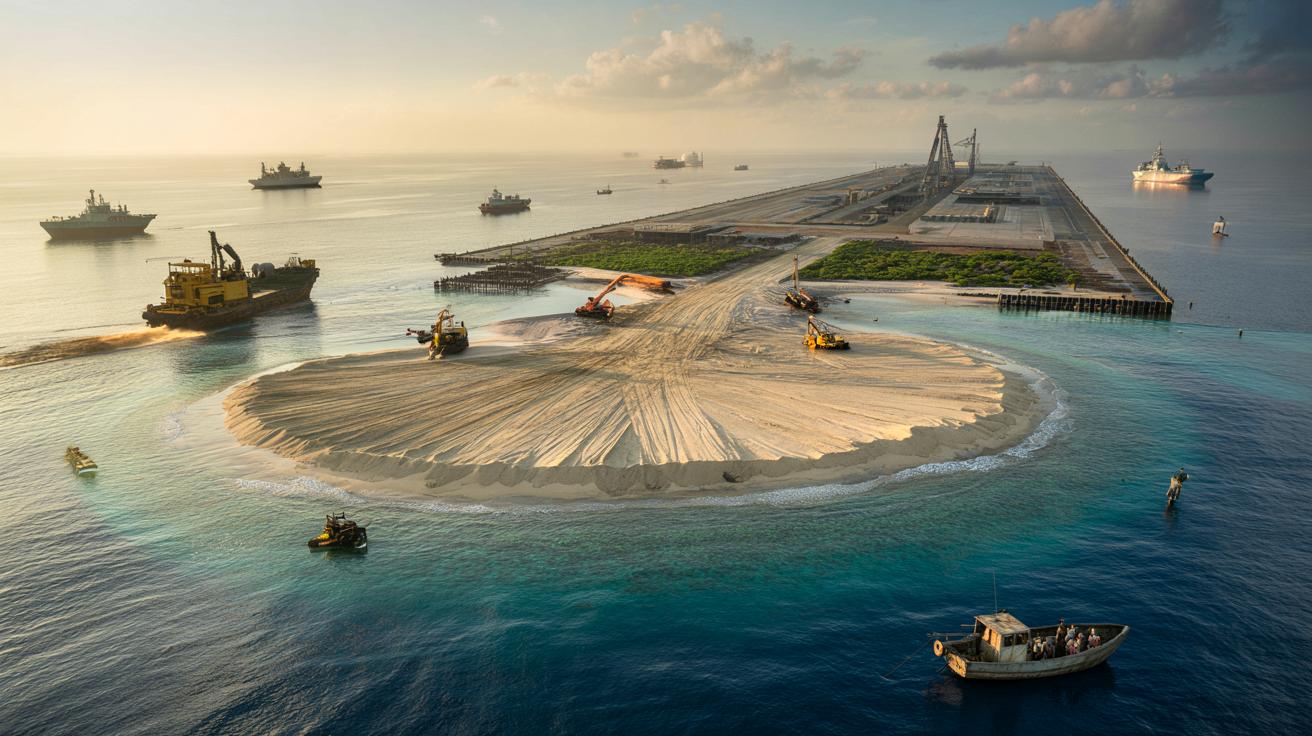
From the window of a small fishing boat, the South China Sea no longer looks like an endless blue horizon. A line of concrete and radar domes now cuts the skyline, where old sailors still swear there was nothing but waves and wind twelve years ago. The captain points with his chin, almost ashamed, toward a glowing airstrip that seems to float on the ocean. “All sand,” he mutters. “Tutta sabbia portata qui dalla Cina.”
It’s a strange feeling, seeing a man-made island for the first time.
You know it’s just engineering, pumps and dredgers and barges. Yet your brain keeps whispering: this shouldn’t be here.
How China turned empty reefs into strategic islands
The story starts with sand. Not the romantic kind that sticks to your feet in summer, but millions of tons sucked from the seabed and spat out onto shallow reefs. For about 12 years, Chinese dredging ships have worked almost like underwater bulldozers, chewing up the ocean floor and piling it on coral outcrops in the South China Sea.
Bit by bit, low-tide rocks became permanent platforms. Platforms became construction sites. Construction sites became islands with names, flags and runways.
Satellite images taken between 2013 and today are brutal in their clarity. You can scroll through time and literally watch Mischief Reef or Fiery Cross Reef inflate like pale scars in the deep blue. What was once a narrow ring of coral barely visible at high tide now stretches into wide, geometric shapes – straight edges, long airstrips, rectangular harbors carved into living reef.
On Fiery Cross Reef alone, analysts estimate that dredgers moved the equivalent of dozens of Great Pyramids of Giza in sand and rock. All this, in a region claimed by several countries, crossed by one of the busiest shipping lanes on Earth.
The logic, behind the sandstorms and the cement, is cold and simple. By turning obscure reefs into full-blown artificial islands, Beijing anchors its presence in a disputed maritime zone rich in fish, gas and strategic routes. These new islands host runways long enough for military jets, deep ports for warships and tall radar towers that can “see” for hundreds of kilometers.
On paper, China calls them civilian facilities and rescue hubs. From the air, the islands look more like unsinkable aircraft carriers quietly locked into place.
The engineering behind “creating land from nowhere”
The method sounds almost childish: find a shallow reef, pile sand on it until it sticks out of the water, then pave it. In reality, it’s a brutal technical ballet. It begins with giant cutter suction dredgers, floating factories that bite into the seabed with rotating heads, sucking up sand and mud through long pipes. The slurry is pumped onto the reef, where bulldozers and excavators shape it into flat platforms.
➡️ Perché il silenzio mette a disagio alcune persone (secondo la psicologia)
➡️ “Questo è il piatto comfort che preparo quando non voglio sapori forti, solo equilibrio”
➡️ Psicologi spiegano perché alcune persone sembrano sempre più stanche degli altri
➡️ Contatore Linky: iniziano ad arrivare lettere ai privati, Enedis chiede 1.359 euro
Only when the sand is stable enough do trucks start arriving with concrete, steel and radar domes.
This is where many outside observers underestimate the process. We’ve all seen those time-lapse videos of skyscrapers going up in Chinese cities, but building in the middle of a typhoon-prone sea is a different game. Engineers need to consider waves, erosion, salt corrosion and subsidence as the sand settles. A miscalculation and the runway could crack or sink.
Yet Beijing pushed ahead, working day and night, even as international tribunals called the construction illegal and neighboring countries protested. Let’s be honest: nobody really reads those legal rulings on reefs unless things go really wrong.
The hidden price of these islands sits beneath the waves. Marine biologists describe entire coral ecosystems crushed under layers of sand, fish nurseries buried, water turned cloudy for kilometers around. Some studies suggest that up to 15 square kilometers of reef were heavily damaged or destroyed by Chinese island-building alone in the Spratlys.
From Beijing’s point of view, though, this is a bargain. A one-time ecological cost in exchange for a permanent strategic advantage. *Land built with dredgers doesn’t sink like ships or rotate like patrol shifts: once it’s there, it’s there.*
Power, perception and the quiet art of changing the map
If you ask officials in Beijing, the narrative is polished. The new islands are framed as “necessary facilities” for search and rescue, safe havens for ships in distress, lighthouses of development. On TV, cameras linger on fresh paint, gleaming docks, weather stations and cute mascots painted on hangar doors.
Yet the length of the runways and the shape of the shelters tell another story to military analysts squinting at satellite photos from Washington, Manila or Hanoi.
There’s a human layer here that often gets lost. Filipino fishermen speak of being chased away from traditional fishing grounds near Scarborough Shoal by coast guard vessels, of laser beams pointed at their boats, of steel and concrete creeping closer each season. Vietnamese crews talk about feeling “encircled” by new Chinese outposts.
We’ve all been there, that moment when a place you thought was yours suddenly feels watched, controlled, claimed by someone else. Scale that up to an ocean, and you get the anxiety that hums in every diplomatic conversation about the South China Sea.
“Land is power, but in the South China Sea, even fake land can shape real politics,” notes a Southeast Asia researcher based in Singapore. “Once you have an airstrip on a reef, you don’t just change the military balance, you change how everyone imagines the map.”
- New islands, new facts on the ground – By turning reefs into permanent bases, China shifts negotiations from “who owns what water” to “who dares to challenge our concrete”.
- Environmental damage as collateral – Coral loss, sand plumes and dredging scars stay long after diplomats have moved on to the next crisis.
- Everyday life transformed – From rerouted fishing trips to nervous cargo captains, the impact quietly ripples through ordinary people’s routines.
What these sand-made islands say about the world we’re entering
Standing on the deck of that fishing boat, watching a cargo plane glide down onto an island that didn’t exist a decade ago, you sense something unsettling. If a country can redraw the coastline with dredgers and political will, then maps start to look less like facts and more like drafts. Yesterday’s “international waters” can slowly feel like someone’s backyard.
For some, that’s terrifying. For others, it’s a glimpse of a future where technology constantly rewrites geography.
This isn’t just about China, or about one contested sea between vague dotted lines on a chart. From Dubai’s palm islands to land reclaimed in the Netherlands and Singapore, we’re entering an era where coastal states see sand and concrete as tools of power, survival and prestige. The Chinese version is simply the most muscular, the most openly strategic, the one that collides hardest with neighbors and law books.
The rest of the world is watching closely, quietly asking itself: if they can do this for reefs, what stops others from doing it for borders, rivers, even melting Arctic coastlines.
No easy moral stands out from those piles of dredged sand. There’s raw ambition, undeniable engineering skill, environmental loss and deep geopolitical dread all compacted into a few square kilometers of artificial land. What looks like a blank concrete runway from space is, up close, a tangle of human hopes and fears: fishermen wondering where to cast their nets next season, pilots landing on a strip that coral once held up, diplomats trying to find polite words for “we see what you’re doing”.
The map is changing in real time. The question lingering in the sea air is whether the rest of us will only react once the new islands are already drawn in thick, permanent ink.
| Key point | Detail | Value for the reader |
|---|---|---|
| Sand as a geopolitical weapon | China has used years of dredging to turn reefs into fortified islands with runways and ports. | Helps you understand how raw engineering can shift power without a single shot fired. |
| Hidden environmental cost | Coral reefs and marine habitats have been buried or damaged on a massive scale. | Shows the real ecological price behind those striking satellite images. |
| Maps are no longer fixed | Artificial land is reshaping borders, perceptions and daily life for neighboring countries. | Invites you to question how “real” our political maps still are in a world of man-made coasts. |
FAQ:
- How did China create these artificial islands?By using large dredging ships to suck sand and sediment from the seabed and pump it onto shallow reefs, then leveling, compacting and covering the new land with concrete and infrastructure.
- Where are these new islands located?Most are in the Spratly and Paracel archipelagos in the South China Sea, in waters claimed by several countries including China, the Philippines, Vietnam, Malaysia and Brunei.
- Are these islands legal under international law?A 2016 ruling by an international tribunal in The Hague said China’s expansive claims and some construction activities violated the UN Convention on the Law of the Sea, but Beijing rejects the decision and keeps operating the bases.
- What are these islands used for?Officially, for navigation safety, research and rescue missions; in practice, they host military-grade airstrips, radar stations, missile sites and harbors that extend China’s reach over the sea.
- How does this affect ordinary people in the region?Fishermen report being pushed away from traditional grounds, tensions at sea have increased, and commercial shipping now sails through a zone where miscalculations between rival navies feel more likely.